The Simplest Way
I Know to Explain
AI Environmental Systems
Not long ago I was trying to explain AI environmental systems to someone who works with AI agents.
I failed terribly.
I knew exactly what I was trying to describe, but I couldn't get it across. I remember talking about a room. Then the carpet in the room. The environment around you. What you put in the room. What the room allows you to do.
It was awful.
The problem wasn't that the idea was complicated. The problem was that I didn't yet have a simple enough example for something that requires looking at AI from a different direction.
I have that example now.
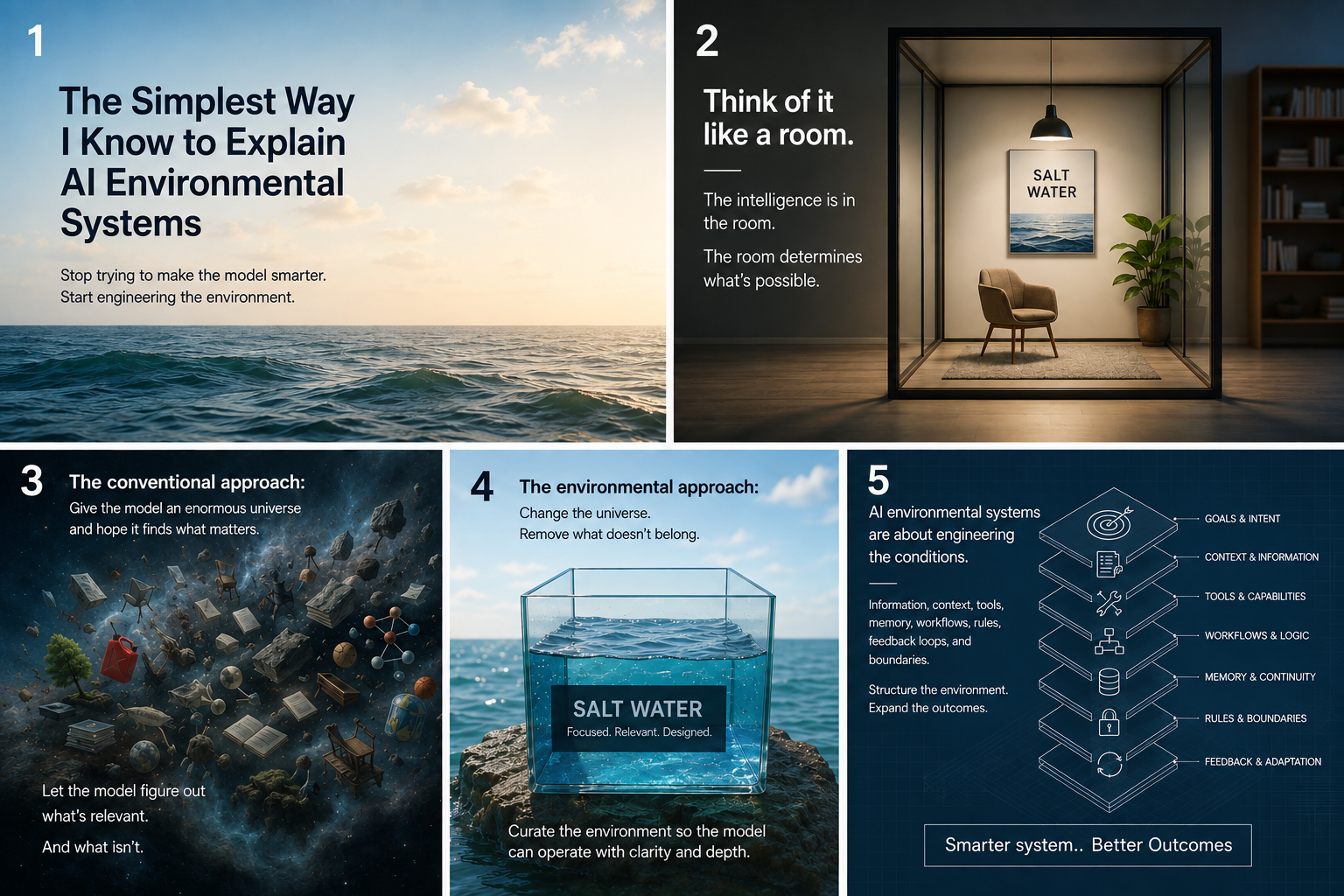
Say you want an AI system to produce a report about salt water.
The conventional approach starts with the model.
How powerful is the model? What does it know? What information can it access? How effectively can it search through that information, identify what is relevant to salt water, discard what isn't, reason over what remains, and produce the report?
The basic assumption is that you have an enormous informational universe, and the intelligence of the model is responsible for navigating it correctly.
AI environmental systems approach the problem from almost the opposite direction.
Instead of starting by asking how well the model can find salt water in an enormous universe, start by changing the universe.
We want to talk about salt water.
Fine.
Then why are rocks in the environment?
Why is gasoline there?
Why is freshwater there?
Why are trees, financial statements, French literature, employment contracts and ten million other things sitting somewhere in the active informational space while we rely on the model to keep figuring out that they don't matter?
Start constraining the environment.
We're dealing with liquids.
Now most of the world is gone.
We're dealing with H₂O.
Now most liquids are gone.
We're dealing with H₂O containing salt.
Now ordinary freshwater is gone.
Set a minimum salinity of X.
Anything below X doesn't qualify.
Keep applying the relevant boundaries until the operating environment contains salt water and perhaps a very small number of things sufficiently similar to salt water that they legitimately belong in the same problem space.
Now give that environment to the model.
That’s a fundamentally different way of thinking about AI.
The model no longer has to repeatedly find one relevant object among thousands or millions of irrelevant possibilities.
We have changed the conditions under which the intelligence operates.
Instead of asking:
“Can this model correctly identify salt water in the world?”
we have constructed a world in which almost everything that isn't salt water has already been excluded from the active problem.
Maybe there are two legitimate possibilities left.
Fine.
Models are very good at distinguishing between two legitimate possibilities.
What we're trying to stop doing is making the model distinguish those two legitimate possibilities from 10,000 illegitimate ones every time it thinks.
That’s the basic idea.
And once you understand it, a lot of the current conversation about AI starts looking incomplete.
We have spent enormous amounts of money, compute and engineering effort trying to make the intelligence more powerful.
Larger models. Better models. More reasoning. Larger context windows. Better retrieval. Better tools.
Etc.
We've made tremendous gains in that field.
But AI environmental systems add another source of capability:
they change the conditions under which that intelligence is working.
You don't necessarily need a different model to get a meaningfully different result.
In our own comparative work at Canon Frameworks, AI environmental governance has produced noticeable differences across the large majority of same-model comparisons we've run. The size of the difference varies considerably by task.
(For what it's worth, the number in our own comparisons is actually 99%. The system wanted me to call it “an estimated 99%.” I argued that “estimated 99%” sounds stupid. So this is what we have here.)
But the pattern itself is hard to miss.
The same model will many times behave very differently when it doesn't need to reconstruct the entire problem space every time it thinks.
That's the question Canon Frameworks is built around.
Canon Frameworks specializes in AI environment and systems architecture. Our primary focus is engineering the conditions around the model to expand what the same underlying intelligence is capable of doing.
Not only:
How much better can we make the model?
But:
How much more capable can AI become when we engineer the environment around it?
That's the question Canon Frameworks is built around.
Canon Frameworks specializes in AI environment and systems architecture. Our primary focus is engineering the conditions around the model to expand what the same underlying intelligence is capable of doing.
Not only:
How much better can we make the model?
But:
How much more capable can AI become when we engineer the environment around it?
Canon Frameworks is the architecture layer for organizations that want AI to operate with clarity, continuity, and authority—at scale.
Smarter system.. Better Outcomes